
Topics
By FoamOrder | February 5, 2021 | 12 Minute Read
Home / DIY & How To / Tips for Painting EVA Foam
Shop Now ›
Before applying any cleaning solution to your microfiber couch, it’s important to remove any loose dirt. If you have a vacuum cleaner with an upholstery attachment, take the time to vacuum every inch of your couch to remove particles of dirt or bits of food. Don’t feel like hauling the vacuum cleaner up or down stairs? Brush the couch with a stiff brush to remove any loose debris.
You’re now ready to find the best cleaning solution for your specific type of microfiber couch.
Microfiber is a man-made material that varies based on processing methods. The way you clean your couch depends on its specific type of microfiber. Somewhere on your couch, you’ll find a tag indicating specific cleaning requirements. The tag may have a “W”, “S”, “X”, or “S-W” on it. Here’s how to decode the message.
“W” : Clean only with a water-based cleanser.
“S” : Clean only with a solvent-based cleanser.
“X” : Dry clean only.
“S-W” : Clean with a solvent- or water-based cleanser.
Can’t find the tag? A solvent-based cleanser will likely work on your couch — but first perform a spot test on an inconspicuous area to make sure.
After understanding the appropriate microfiber cleansers, you’ll want to tailor your cleaning strategy to tackle some of these common dirty offenders.
Pet accidents happen. Leaving pet urine stains on your microfiber couch is both unhygienic and offensive to anyone who comes to visit.
If possible, remove the microfiber covers from your seat cushions. If your couch’s care tag says “W” or “S-W”, immediately throw the covers into your washing machine at home for quick, effective cleaning. While the covers are in the washing machine, examine your seat cushions. Are they made of a good-quality dense foam that can be wiped clean with a disinfectant? If not, you’ll just be putting clean microfiber covers back on a dirty couch.
At FoamOrder.com, you can get replacement cushions for your sofa that are made of natural latex rubber. Upgrading your cushions with these high-quality foam replacements ensures that you’re ready for whatever accidents happen on your couch.
After your microfiber covers are finished washing, you’ll want to let them air dry to make sure they don’t shrink in the dryer.
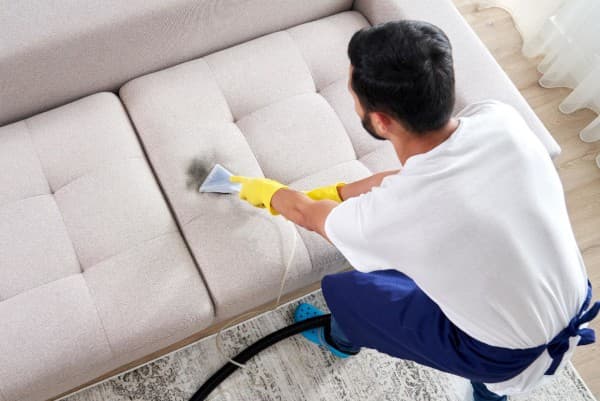
If you can’t remove your microfiber seat covers, or if the accident happened on another part of the couch, you can steam clean your sofa to help remove urine stains and kill germs.
Here are some other ways to effectively spot-clean pet urine stains on your microfiber couch.
If your microfiber couch’s care tag says “W” or “S-W”, a vinegar and water compound is an alternative option for cleaning pet urine stains.
Here’s what you’ll need.
If your microfiber couch’s care tag reads “S”, use a solvent-based cleanser to remove pet urine from your furniture. Clean your couch with an item you already have in your pantry. The chemical properties in salt help to dry up fresh urine stains and clean the area without damaging your couch’s material.
Have these items on hand for this cleaning solution.
Microfiber repels water but absorbs grease. This can be a problem if your couch regularly doubles as a dinette set for family mealtimes. If your microfiber couch has suffered from one too many fried food mishaps, it’s time to refresh it with targeted cleaning.
Watermarks are unsightly rings that appear on almost all microfiber couches at some point. They are usually produced when liquid spills on the couch or when someone uses too much water while spot-cleaning. Here are some ways to clean your microfiber couch whether it needs a water-based or solvent-style cleaning solution.
Standard Cleaning Materials Needed
For microfiber couches that require water-based cleaners, you’ll need these items.
For couches that require a solvent-based cleanser, use a rubbing alcohol solution. Here are the things you’ll need.
A visibly dirty couch is only slightly more embarrassing than a smelly one. Strong odors emanating from your microfiber couch can be caused by pets or people. Whether you have a beloved pet you’d never think about getting rid of or a hand-me-down couch you’re stuck with for the moment, you’ll love this simple odor-removing trick.
Have a toddler in the house? Still holding on to 20th-century writing implements? Chances are high that your microfiber couch has been or will become the canvas for some pretty interesting artwork. Thankfully, removing ink stains from your microfiber sofa is a fairly straightforward endeavor.
Now that we’ve gone over the best cleaners for microfiber couches, let’s look at some of the worst. While these products are good for certain cleaning tasks, we advise against using them on microfiber — or at least to be careful when doing so.
Hydrogen Peroxide
Hydrogen peroxide is an excellent household cleaner that naturally kills odor-causing bacteria. Do-it-yourself couch cleaners use this inexpensive germ-fighter to remove watermarks and other tough stains. When asked if a hydrogen peroxide-based cleaning solution works on microfiber couches, we must say that it does. But because hydrogen peroxide has well-known bleaching properties, proceed with caution when cleaning your microfiber couch.
Windex
When it comes to commercial cleaning products, Windex has a surprisingly huge fan base. The popular blue window cleaner has no clear connection to upholstery cleaning, so we have no idea how it came to be known as some people’s go-to microfiber couch cleaner. However, no one can argue with the results: Windex works. You should proceed with caution when using this product on light-colored microfiber couches, however. Windex contains a distinctive blue dye that can discolor your couch.
Hairspray
Surprisingly, some people use hairspray to remove stains from their microfiber couches. But the success rate for this cleaning solution is hit or miss, and we don’t recommend trying it. The reason some people have success with hairspray is because of its high alcohol content.
However, alcohol is overly drying, and some hairspray manufacturers have lowered the alcohol content in their products to avoid drying out people’s hair. Instead, they use filler ingredients such as oily emulsifiers, which can make microfiber couches dirtier than before a “cleaning.” Next, you’ll be trying to figure out how to remove hairspray from your microfiber couch. By the way, we did see a request from someone who needed to remove hairspray from her microfiber couch.
The ultimate cleaning guide for microfiber couches wouldn’t be complete without advice from your peers. These outtakes from the cleaning community include helpful hacks that worked for some microfiber couch owners as well as some funny advice you should take at your own risk.
To extend the life of your microfiber couch, a little preventive maintenance goes a long way. Here are some top options for keeping your couch looking and smelling like it actually belongs in your home.
Get monthly updates on
promotions, deals, and
new products.
Recommended For You






Quickly iterate business relationships, then progressively embrace excellent communities, then fungibly deliver high-quality applications.


